One Street, Five Churches: Reading a Neighborhood Through Its Churches
On a map, several churches close together can look like duplication. On foot, they invite a better question: what brought each community here? A steeple, a second language on a noticeboard, or a former sanctuary with a new use can reveal different chapters of the same neighborhood. The title is a walking prompt, not a claim that this article reports five churches on one verified street; Cleveland’s Tremont offers a documented neighborhood example.
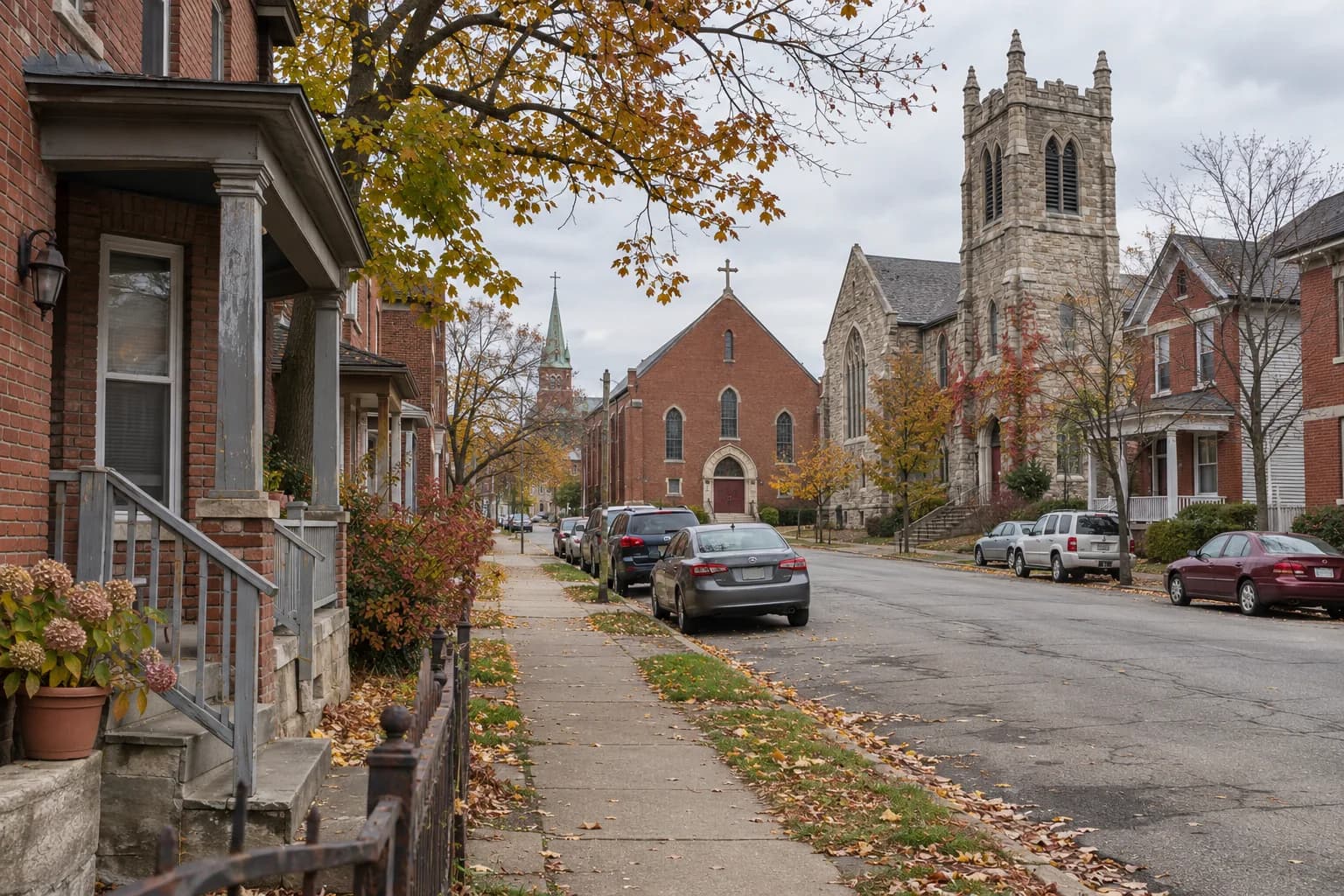
Read the buildings together, but let each congregation tell its own story. Proximity does not mean shared beliefs, shared origins, or present-day collaboration.
Your quick checklist
- Choose a walkable area and verify each building’s current identity.
- Separate a congregation’s founding date from the date of its building.
- Compare local archives with the congregation’s own account.
- Ask permission before entering or photographing people.
The map is not the story
A row of church markers tells you where buildings stand. It does not tell you which congregation owns them, which languages people speak, or how far worshippers travel. Some congregations serve immediate neighbors; others gather people from across a city. Begin with the map, then resist the temptation to let it answer questions it cannot.
Look for more than architectural contrast. Compare names, public histories, service notices, and evidence of shared premises. The same tradition can contain several languages and communities. Two buildings with similar towers may have quite different histories, while two very different rooms may belong to closely connected congregations.
A real example: Cleveland’s Tremont
Cleveland State University’s public-history project offers a church tour through Tremont. Its account connects the neighborhood’s religious buildings with successive immigrant communities. The tour includes Annunciation Greek Orthodox, Immanuel Evangelical Lutheran, Holy Ghost Byzantine Catholic, Pilgrim Congregational, and St. George Antiochian Orthodox churches among its stops.
This is a neighborhood trail, not five buildings claimed to stand on one street. It demonstrates how worship sites can help explain settlement and cultural continuity. Treat the historical tour as background: building uses and access may have changed since individual entries were written. Confirm current details with the relevant congregation before planning a visit.
A language can be part of belonging
For a newcomer to a city, worship in a familiar language may connect a new address with an older home. A congregation can preserve songs, family memories, and ways of marking important occasions. Later generations may choose another language or combine several. None of those changes, by itself, tells you whether the community is thriving or fading.
Ask how the congregation describes that transition. Avoid treating ethnicity as a permanent label or inferring someone’s origin from the church they attend. A historic name may outlast the community that first chose it. The interesting story is how people explain continuity and change in their own words.
Every building may have two biographies
One biography belongs to the structure: when it was built, altered, damaged, or reused. Another belongs to the congregation: when it formed, moved, merged, or changed its name. Those timelines overlap without being identical. A cornerstone may date the building while a website celebrates a much older community.
Write both timelines before drawing conclusions. A different name on an old church does not necessarily mean abandonment. Nor does a preserved façade prove continuity of worship. An address can hold several histories, and the current occupants deserve to be described as a living community rather than merely the latest chapter of someone else’s building.
Neighbors, not entries in a ranking
A church walk can drift into a contest of impressive interiors. Try a different question at each stop: what does this place help us understand about the neighborhood? A modest hall may tell you more about a recent arrival than an elaborate tower. A locked door may tell you nothing beyond the opening arrangements that day.
Do not infer harmony or hostility from distance. Congregations might cooperate, barely know one another, or share occasional events while retaining deep differences. Look for specific evidence before describing a partnership. Ask the same respectful questions everywhere, and leave room for answers that complicate your initial impression.
Build your own small church-history walk
Start with three to five places that can be reached comfortably. For each, note a verified name, a dated historical fact, one question, and whether entry is currently available. Use public pavements and published visitor arrangements. A rewarding route does not require every interior to be open.
Use NearMeChurch to discover possible stops, then cross-check official websites and local archives. Share uncertainty honestly: an unconfirmed date is a question to investigate, not an invitation to guess. The best result is a richer way of seeing an ordinary street, with curiosity left over for the next walk.
By denomination
These notes cover the ten traditions in our denomination guide. They combine background with practical questions to ask. A source from one church body does not speak for every church in its wider tradition; confirm local arrangements with your congregation.
Orthodox Christianity
Distinguish the specific Orthodox jurisdiction and the community’s own cultural history. Do not assume that every church with an Eastern-looking dome uses the same language or has the same national origins.
Catholic Christianity
Check whether a Catholic church is Latin or belongs to an Eastern Catholic tradition. Architectural resemblance alone cannot distinguish Eastern Catholic and Orthodox communities; consult the congregation’s own identification.
Baptist Churches
Ask about the congregation’s founding, affiliations, and moves. Similar Baptist names may belong to independent local histories, while an older building may have served another tradition before its current congregation.
Pentecostal Churches
Ask whether a Pentecostal community began at this address or moved into an existing building. Language, migration, and renewal may be relevant, but only the local history can establish which themes apply.
Lutheran Churches
Explore whether language or immigrant settlement appears in a Lutheran congregation’s documented history. Avoid assuming that a historic ethnic connection describes everyone who worships there today.
Methodist and Wesleyan Churches
Look for chapel names, former circuits, and records of mergers where relevant. Methodist and Wesleyan histories vary by country; a familiar architectural style is only a clue to investigate.
Presbyterian and Reformed Churches
Distinguish Presbyterian, Reformed, and Congregational identities rather than treating them as interchangeable. Ask the congregation which affiliations and historical names belong in an accurate account.
Anglican and Episcopal Churches
Ask whether the church began as a territorial parish, a mission, or another form of congregation. Anglican and Episcopal labels reflect different national settings and do not settle a neighborhood’s local history.
Seventh-day Adventist Churches
Include Saturday worship when reading a neighborhood’s weekly rhythm. A quiet Sunday exterior does not establish that an Adventist church is inactive; verify its schedule and local story directly.
Nondenominational and Independent Churches
Look beyond historic church architecture: an independent congregation may occupy a shop, school, or shared hall. Establish its own history without assuming that an unremarkable exterior means a new or temporary community.
Prepared by NearMeChurch with AI assistance. Linked church sources explain specific practices; local arrangements can change. Suggest a correction.